Retrospective · IPL 2026 · 13 May
RCB vs KKR Raipur retrospective: predicted XIs, pitch and weather from May 13, 2026
Royal Challengers Bengaluru brought first place but a vulnerable batting order to Raipur. Kolkata Knight Riders arrived with four consecutive wins, an in-form Finn Allen and uncertainty over Varun Chakaravarthy. The pre-match evidence made the neutral venue more important than either team's reputation.
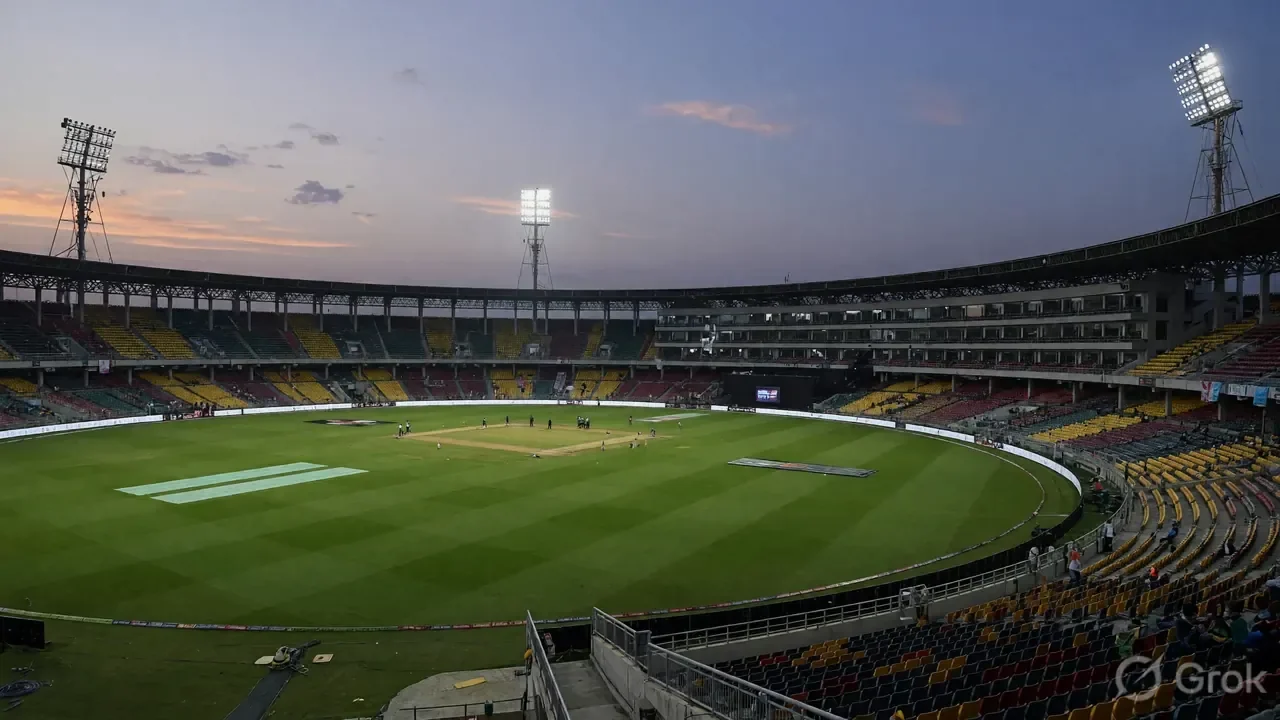
Royal Challengers Bengaluru and Kolkata Knight Riders were due to meet at the Shaheed Veer Narayan Singh International Cricket Stadium in Raipur on Wednesday, May 13, 2026. The toss was scheduled for 7:00 PM IST and play for 7:30 PM IST. Read retrospectively, the preview captured a compelling league-stage contrast: RCB occupied first place and were pursuing a top-two finish, while KKR had revived their playoff prospects with four straight victories after collecting only one point from their opening six matches.
The report, published by Yahoo Sports and syndicated from the TOI Sports Desk on the morning of the match, supplied probable teams, injury notes, the rivalry record, pitch conditions and the weather forecast. It did not report the result. Any assessment here therefore stays within that pre-match frame: what could reasonably have been inferred before the toss, and which uncertainties still required confirmation.
- Match: Royal Challengers Bengaluru vs Kolkata Knight Riders, IPL 2026 league stage
- Date: Wednesday, May 13, 2026
- Venue: Shaheed Veer Narayan Singh International Cricket Stadium, Raipur
- Toss: 7:00 PM IST
- First ball: 7:30 PM IST
- Television: Star Sports Network
- Streaming: JioHotstar
Why the table did not tell the whole story
RCB's position at the top of the table suggested control, yet the state of their batting created a more fragile pre-match picture. They had just beaten Mumbai Indians at the same ground with a last-ball finish, keeping a top-two place within reach. That narrow result mattered because it showed both resilience and a lack of margin. A side can lead a competition while still carrying a weak area into its next fixture, and RCB's weak area was clear.
Phil Salt remained sidelined by injury. Jacob Bethell had struggled in his recent appearances. Virat Kohli entered the match after consecutive ducks. Jitesh Sharma and Romario Shepherd had also been short of runs. Those details did not automatically make RCB underdogs, but they shifted the emphasis away from status and toward role security. The batting order needed Kohli or Devdutt Padikkal to give the innings shape; otherwise Rajat Patidar and the middle order risked facing KKR's strongest phase too early.
KKR's form line moved in the opposite direction. One point from six matches had left them close to elimination, yet four wins in succession restored their playoff hopes. The revival invited comparison with RCB's recovery in 2024 after seven defeats in eight matches. More immediately, Finn Allen had just scored an unbeaten century from 47 balls. That innings gave KKR an opener capable of changing the powerplay before Raipur's surface could slow the scoring rate.
The central prediction question was therefore not simply first versus recovering challenger. It was whether RCB's stronger season could absorb another uncertain top-order performance, or whether KKR's current momentum would transfer to a neutral black-soil pitch that appeared less friendly to free scoring.
RCB's predicted XI and the choices hidden inside it
The projected RCB XI was Virat Kohli, Jacob Bethell, Devdutt Padikkal, Rajat Patidar as captain, Venkatesh Iyer or Romario Shepherd, Jitesh Sharma as wicketkeeper, Tim David, Krunal Pandya, Bhuvneshwar Kumar, Josh Hazlewood and Suyash Sharma. Rasikh Salam Dar or Jacob Duffy was listed as the possible impact player.
The uncertainty between Iyer and Shepherd was significant because the two options changed the balance. Iyer strengthened the specialist batting and offered a left-handed presence through the middle overs. Shepherd supplied seam bowling and late-innings power, but his recent lack of runs reduced the certainty of that trade. On a surface expected to help bowlers, the additional bowling option had merit; against a KKR side carrying momentum, the extra batter also had a strong case.
Kohli's two ducks were impossible to ignore, but they should not have been treated as proof that another failure was likely. Two innings are a warning rather than a dependable forecast. More useful was the change around him: Salt's absence removed a settled opening partner, Bethell had not provided consistent support, and the pressure on the first wicket increased. A prediction based on roles would still recognise Kohli's opportunity at the top while reducing confidence in the stability of RCB's powerplay.
The bowling group looked better matched to the venue. Bhuvneshwar could test the new ball, Hazlewood offered hard lengths, and Suyash provided wrist-spin if the black soil gripped. Krunal's ability to bowl and bat deepened that combination. The impact-player decision between Rasikh and Duffy appeared likely to depend on the final surface and whether RCB were defending or chasing.
KKR's predicted XI and the Varun Chakaravarthy question
KKR's projected XI was Ajinkya Rahane as captain, Finn Allen, Angkrish Raghuvanshi as wicketkeeper, Cameron Green, Rovman Powell, Manish Pandey, Rinku Singh, Sunil Narine, Anukul Roy, Kartik Tyagi and Vaibhav Arora. Varun Chakaravarthy or Navdeep Saini was named as the impact-player option.
Allen's recent hundred made him the obvious form player, but KKR's recovery was not a one-man argument. Rahane provided an experienced opening presence, Raghuvanshi added a top-three wicketkeeper role, and Cameron Green gave the side an all-rounder through the middle. Powell and Rinku supplied finishing power, while Pandey could steady an innings if the powerplay went badly. Narine and Anukul lengthened the spin resources and the batting.
Chakaravarthy was the major unresolved detail. He had taken eight wickets across his previous four matches, yet an injury suffered during the matches against Sunrisers Hyderabad and Delhi Capitals made him doubtful. His availability could have changed the contest sharply. RCB's unsettled middle order would have faced one of KKR's most productive bowlers on a surface expected to provide grip. If he was not fit, Saini offered pace but not the same middle-overs problem.
That uncertainty required restraint before the toss. Naming Chakaravarthy as a decisive pick without confirmation would have confused a probable option with a confirmed selection. The sound pre-match position was conditional: KKR's bowling advantage increased if he passed fitness; if not, the responsibility on Narine, Anukul, Tyagi and Arora became substantially heavier.
The head-to-head record favoured KKR, but only as context
The source printed the rivalry record as 15 wins for RCB and 20 for KKR across the listed meetings. The wording around the number was awkward, but the aggregate clearly gave KKR a five-win advantage. Historical results supported the idea that KKR had generally handled this match-up better.
That record was not a stand-alone prediction. Squads, venues and roles change, and this meeting was staged in Raipur rather than Bengaluru or Kolkata. RCB's first-place standing represented the current season better than the long rivalry did; KKR's four-match streak represented current form better still. The useful reading was to place the numbers together: KKR held the historical edge and arrived with the stronger immediate sequence, while RCB held the stronger position across the season as a whole.
Such a split calls for a measured forecast rather than certainty. It made KKR a credible challenger despite the table, especially if Chakaravarthy played. It did not erase RCB's bowling quality, their experience of the Raipur conditions from the Mumbai match or the value of being first in the standings.
Raipur's black-soil pitch brought bowlers into the forecast
The pre-match report described the Shaheed Veer Narayan Singh International Cricket Stadium surface as balanced black soil and more helpful to bowlers than the flat, high-scoring grounds seen elsewhere in IPL 2026. That was the strongest environmental clue in the preview. It discouraged the assumption that a recent centurion or a famous top order would automatically dictate the match.
A balanced surface can reward several bowling methods. New-ball seamers can use any early movement, spinners can benefit if the ball grips, and pace variations can become harder to hit cleanly once the surface slows. RCB appeared well equipped for that mix through Bhuvneshwar, Hazlewood, Suyash and Krunal. KKR's best response depended partly on Chakaravarthy, with Narine and Anukul still available if he missed out.
The pitch also increased the cost of a poor powerplay. When boundaries are less automatic, losing two early wickets exposes middle-order batters before they can assess pace and bounce. That was especially relevant to RCB because Salt was absent and Kohli and Bethell entered without recent runs. It was relevant to KKR because Allen's aggressive opening role could either break the surface's influence or give RCB the early wicket they needed.
No verified par score was supplied, so assigning a precise first-innings target would have gone beyond the evidence. The defensible conclusion was narrower: the surface appeared less likely than other 2026 venues to reward indiscriminate hitting, and the teams' bowling resources deserved more weight than a generic IPL expectation of a run-heavy night.
Clear weather removed rain uncertainty; dew complicated the toss
The weather forecast called for clear and dry conditions with no chance of rain during match hours. Temperatures were expected to cool to 27°C under a clear sky. A complete 40-over match was therefore expected, removing the shortened-game volatility that can make probable XIs and role projections less reliable.
Moderate dew was forecast for the second innings. Dew can make the ball harder to grip, reduce the bite available to spin and improve the value of chasing once the surface has been seen. At the same time, the report characterised the pitch as more helpful to bowlers than many other grounds. Those two forces pointed in different directions: the surface supported defending bowlers, while later moisture could soften that advantage.
The 7:00 PM toss consequently mattered beyond the routine choice of batting or bowling. A captain who chose to chase could gain from the dew but still risk allowing the opposition to use the best early bowling conditions after setting a total. A captain who batted first could avoid a difficult initial chase on an unfamiliar surface but leave the bowling side handling a damp ball late in the evening.
Because the source did not report the toss outcome, the retrospective cannot turn that choice into a confirmed claim. Before the toss, however, a slight preference for chasing was reasonable if the visible pitch remained balanced and the dew forecast held. Confirmation of Chakaravarthy's fitness would also have mattered: KKR might have been more willing to defend if their leading wicket-taker was available, while his absence would have made a chase more attractive.
What a disciplined pre-match prediction could say
The evidence supported a close contest rather than a strong favourite. RCB had the better season and a bowling attack suited to Raipur, but their batting was carrying more active concerns. KKR had the historical advantage, four consecutive wins and Allen's explosive form, but one of their most important bowlers was an injury doubt.
A conditional prediction would have leaned slightly toward KKR if Chakaravarthy was declared fit. His recent eight-wicket return across four matches, added to KKR's winning run and the rivalry record, would have matched well with RCB's unsettled batting. If he was unavailable, the assessment moved closer to even and RCB's Hazlewood-Bhuvneshwar combination became the more dependable bowling unit.
The safest player-role expectations were Allen for attacking powerplay involvement, Rahane for stability, Kohli for volume at the top despite recent failures, and the principal new-ball bowlers on both sides. Chakaravarthy belonged in any prediction only after fitness confirmation. Bethell, Shepherd and Jitesh were higher-variance choices because their recent form had not matched the importance of their likely roles.
The forecast also favoured patience at selection time. Probable XIs should remain provisional until the toss, particularly where RCB had an Iyer-or-Shepherd choice and KKR had a Chakaravarthy-or-Saini impact option. The value of the preview was not pretending those decisions were known. It was identifying which decisions would alter the balance once the official teams were announced.
A dated preview that still demonstrates sound match reading
The May 13, 2026 preview remains useful because it separates three kinds of evidence that are often blurred together. RCB's table position was confirmed season evidence. KKR's four-match winning run and Allen's century were recent form. The predicted XIs, Chakaravarthy's availability and the toss were unresolved pre-match information. Treating each category differently prevents a forecast from sounding more certain than the source permits.
It also shows why venue analysis belongs beside team analysis. A flat pitch might have made Allen's century and RCB's batting names the dominant story. Raipur's balanced black soil instead increased the importance of Hazlewood, Bhuvneshwar, Suyash, Narine and potentially Chakaravarthy. Clear weather removed one source of uncertainty, while moderate dew introduced a tactical choice for the second innings.
For readers assessing comparable fixtures, the practical sequence is simple: confirm injuries, compare probable and official XIs, establish the surface type, check rain and dew separately, and only then weigh current form against the head-to-head record. The continuing IPL match prediction coverage applies that sequence to each relevant fixture without presenting provisional information as fact.
Source record: Yahoo Sports, syndicated from the TOI Sports Desk, published May 13, 2026. The verified report supplied the fixture details, table context, team form, injury notes, predicted XIs, head-to-head figures, pitch description, weather forecast and broadcast information used above. No result or post-match score was added.